In that context, it’s easy to conclude that the real problem is a lack of time. Yet our experience working with managers has shown us that it’s often useful to look a little deeper. Because many managers don’t simply lack time. Sometimes, they lack the space to do their real work.
When urgency takes over
Across the organizations we support, we often observe the same pattern. Managers start their week with good intentions. They want to meet with their employees, follow up on certain matters, work on their projects and move their priorities forward.
Then reality catches up with them: a client calls with an urgent issue, an employee is absent, a file falls behind, another meeting is added to the schedule. At the end of the day, the manager has worked nonstop but feels as though all they have done is react to events.
Gradually, certain responsibilities keep getting pushed back: one-on-one meetings, coaching, employee development, performance discussions or succession planning. Yet these are precisely the activities that have the greatest long-term impact.
Being busy isn’t always the same as being effective
There is an important difference between being busy and being effective. We work with many managers who put in very long hours. They are constantly being pulled in different directions. Yet when we look more closely at their reality, we realize that a large part of their time is spent solving problems they have already solved before.
The same question keeps coming back. The same decision has to be validated again and again. The same issues reappear week after week. At that point, it’s fair to ask a question.
Is the problem really a lack of time, or has the organization become too dependent on the manager?
The distinction matters. Because a manager who has to intervene in every decision inevitably becomes the bottleneck for the team.
The trap of the indispensable manager
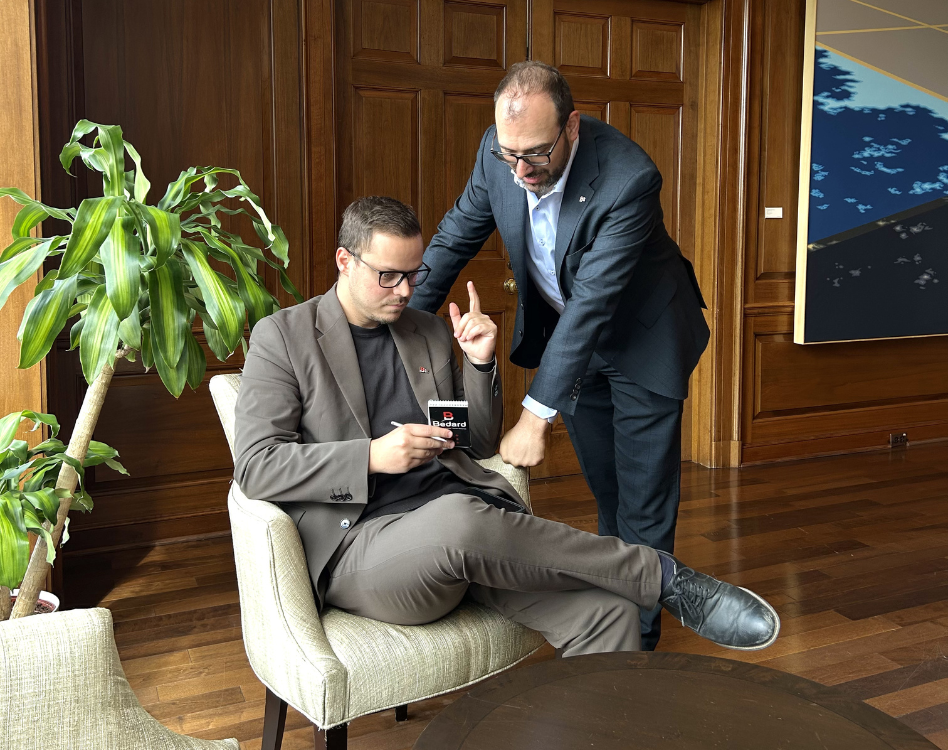
One example from our work illustrates this reality well. A leader we supported some time ago was seeing strong growth in his company, but he constantly felt overwhelmed.
Whenever a file moved forward, someone needed his approval. Whenever a problem arose, the team turned to him. Whenever a decision had to be made, he was involved.
At first, he saw this situation as proof of his importance within the organization, until he realized that the more the company grew, the more his presence was required to keep operations running. And that wasn’t a sign of success. It had become a risk. Because an organization that constantly depends on one person will eventually reach a limit.
Why delegating is so difficult
When we talk about delegation, many managers quickly agree with the principle. In practice, however, things are often more complicated because delegating can take more time in the short term. You have to explain, provide support, answer questions and tolerate some learning mistakes, whereas handling the situation yourself is often much faster.
That’s precisely what makes this trap so difficult to avoid.
Every decision the manager makes may seem to save a few minutes today. But over time, those decisions often end up costing far more time than they saved. Meanwhile, employees develop less autonomy and take less initiative.
The hidden cost of not having enough time
When a manager continually postpones leadership-related activities, the consequences don’t appear immediately.
Operations continue, projects move forward and results generally remain acceptable.
However, certain signs gradually begin to emerge. Employees receive less feedback. Follow-ups become less frequent. Skills development slows down. Problems are addressed later than they should be. Succession remains underdeveloped. And gradually, the manager ends up with even more situations to manage.
The lack of time the manager feels today is sometimes the direct consequence of the time they were unable to invest earlier.
Management is rarely urgent. But it is essential.
That’s probably one of the greatest challenges of the role. Managing employees is rarely the most urgent activity in a day. A coaching meeting can almost always be postponed. A development discussion can wait until next week. A follow-up with an employee can be moved to later.
However, when these delays become a habit, the effects eventually begin to show. The managers we support who deliberately protect time for their management responsibilities are not necessarily those who have less work. They understand that supporting their employees isn’t a secondary activity. It’s a central part of their role.
Regaining control of your schedule
At Bedard Human Resources, we regularly work with managers who feel significant pressure related to time. Often, we help them take a step back and rethink how they use their energy every day.
Because in the end, the question isn’t only how many hours we work. The question is whether those hours are invested in the right places. After all, a manager doesn’t create value only by solving today’s problems.
A manager also creates value by developing the people who will enable the organization to solve tomorrow’s problems.
And sometimes, the best way to find more time isn’t to work more.
It’s to stop being the answer to every question.
Looking to review your management practices, strengthen team autonomy or better structure your priorities? The experts at Bedard Human Resources can support you. To learn more about our HR consulting services, contact Stéphane Pépin at spepin@bedardressources.com .